
Chattooga Parole and Probation Compared
Parole and probation can both place a released Chattooga County person under rules in the community, but they begin in different ways. Parole follows a period in state prison. The State Board of Pardons and Paroles makes the release decision, and the Georgia Department of Community Supervision, or DCS, handles day-to-day community supervision. Probation comes from a court sentence. A judge may order probation instead of confinement, after a jail term, or as part of a split sentence. DCS supervises felony probation and parole. DCS oversees Georgia's misdemeanor probation system, but the agency says direct misdemeanor supervision does not reside with DCS. The sentencing order should identify that provider.
The record sources are different too. A Chattooga County jail discharge record from Sheriff Mark A. Shrader's office proves when and under what order a person left jail. It does not prove parole. The Board record shows parole action or parolee status. A DCS office confirms the assigned supervision channel, while the court file shows the probation sentence. Those records should agree before a status is treated as settled.
| Point | Parole | Probation |
|---|---|---|
| How it starts | Board-authorized release from a GDC sentence | Court sentence or order |
| Main decision record | State Board parole record | Sentencing or probation order |
| Community supervision | DCS | DCS for felonies; named local provider for misdemeanors |
| How it ends | Board or sentence discharge reflected in official records | Completion or court-ordered discharge |
- Parole
- Conditional release from state prison before the sentence's maximum end, followed by community supervision.
- Probation
- A court-ordered sentence served in the community under stated terms.
- TPM
- A tentative parole month for final Board review, not a final release date or proof of parole.
- Discharge
- The formal end of custody or supervision shown by the responsible agency or court.
Note: Release from Chattooga County Jail can occur on bond or a court order without creating either parole or probation supervision.
Verify Chattooga Post-Release Supervision
Start with the custody type. A person released from Hays State Prison or another GDC facility may have a Board parole record and a DCS assignment. Someone who left Chattooga County Jail after a felony case may have probation in the Superior Court sentence. A misdemeanor probation case can point to a provider other than DCS. Names alone are not enough. Compare the GDC number, court case, date of birth, sentence, and custody history where those identifiers are available.
- Check the State Board Parolee Search for a released parolee. Use exact spelling first and compare the result with known case or GDC details.
- If the person is still in GDC custody, use the Inmate TPM Lookup. A TPM describes a possible review month, not current parole supervision.
- Review the Chattooga court sentence or probation order. The clerk's file identifies the court action and can show whether probation was ordered.
- Contact the DCS LaFayette Field Office when a parole or felony probation record points to community supervision in this service area.
- For misdemeanor probation, use the court order to identify the governmental or private provider. DCS oversight does not mean the LaFayette office directly supervises that case.
- If records conflict, request the Board, DCS, or court record from its official custodian instead of relying on an old roster or a status copied elsewhere.
The State Board also operates a parole and corrections call center at 404-656-4661 for parole consideration and eligibility questions. That call center does not replace a court record for probation. The broader Chattooga County released-inmate search explains how the jail discharge record and court disposition establish the earlier custody release.
Chattooga Supervision Runs Through LaFayette
Chattooga County does not have a Summerville-labeled DCS field office in the sources reviewed. The assigned local channel is the DCS LaFayette Field Office. It serves Chattooga, Catoosa, Dade, Walker, and the Lookout Mountain Judicial Circuit. That regional structure matters. A person may live in Chattooga County or have a Chattooga court case while reporting to an office in Walker County.
The official DCS LaFayette office page is the best source for current office details. It lists the coordinating chief and confirms the counties served. Reporting instructions, an assigned officer, or a court order may give more specific directions, so the office listing should be used to verify contact rather than to assume where any one person must appear.
Georgia DCS LaFayette Field Office
702 E. Villanow Street
LaFayette, GA 30728
Phone: 706-638-5531
Fax: 706-403-2541
Hours: Monday-Friday, 8:00 a.m.-4:30 p.m.
The DCS contact and open-records page gives a separate statewide record path. Its Open Records Custodian receives requests at 2 Martin Luther King Jr. Drive SE, East Tower, Suite 866, Atlanta, GA 30334. Questions may be directed to 404-463-2072. Some supervision information may be restricted, so a public request may not produce every operational detail.
The captured DCS contact source shows the statewide record route used alongside the local office:
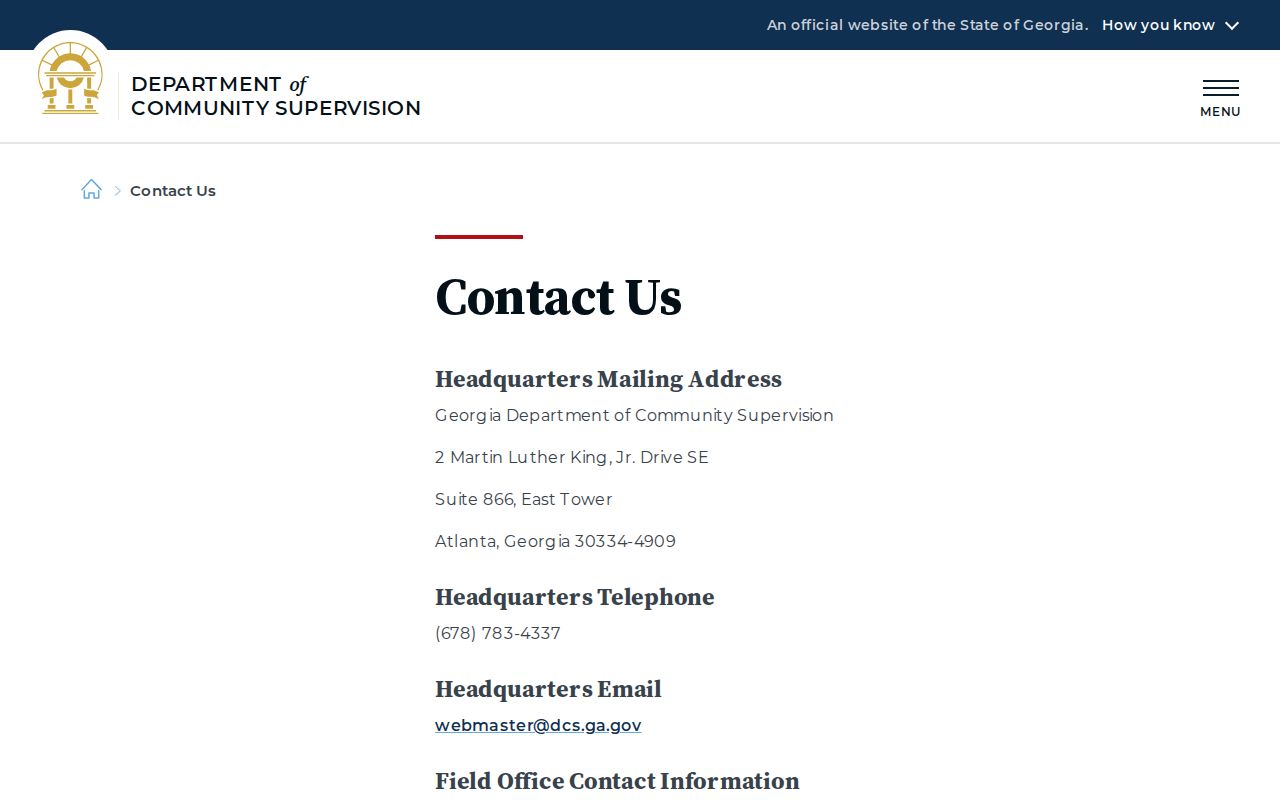
That statewide record channel supports formal verification when a field-office listing or public parole result does not resolve the supervision question.
Note: Field-office service areas can cross county lines, so an out-of-county reporting address does not disprove Chattooga County supervision.
Chattooga Parole Decisions and Meetings
The State Board makes parole decisions statewide. Its public systems serve different purposes. The TPM lookup is for an inmate still under consideration. The Parolee Database is for a person with a parolee record. Board meeting notices, agendas, and videos document public Board business, but they are not an inmate-by-inmate decision calendar. The Board's June 2026 meeting notice specifically said offender cases were not discussed or considered at the monthly public meeting.
For a Chattooga County person, use the inmate or parolee lookup for individual status. The Board's press-release archive publishes meeting notices, agendas, changes, and cancellations. Its public Events page may have no listed event at a given time. Neither page should be read as a promised hearing date for a named inmate.
Common results also require care. A TPM means final review is planned for a tentative month. A grant can still depend on a release plan and required conditions. A denial keeps the person in custody pending any later review or sentence end. A postponement moves review or release. A rescission or cancellation means release will not proceed as once expected. A max-out release comes from sentence completion rather than parole.
Chattooga Parole Eligibility and Conditions
Georgia parole eligibility is not a promise of release. Under O.C.G.A. § 42-9-45, automatic initial consideration follows Board rules and does not require a formal application. The general baseline is six months or one-third of a misdemeanor sentence and nine months or one-third of a felony sentence, whichever is greater. Other laws can change or bar eligibility. The Board identifies serious violent felony non-life sentences with qualifying crime dates, certain recidivist sentences, and life without parole among the categories not eligible.
Conditions are the rules attached to supervision. They may address reporting, travel, treatment, payment, contact, or conduct, but the exact terms come from the person's order. A violation allegation can lead to a warrant, hearing, changed terms, or a return to custody. It does not create a new release record by itself. Official Board, DCS, court, and jail records must be read in sequence.
An absconder is a supervised person alleged to have stopped reporting or left supervision without approval. No official Chattooga-specific public absconder list was found in the reviewed sources. Do not infer that status from a missed contact or an old web entry. If a Board result displays an absconder or warrant notation, confirm it through the responsible agency. For urgent safety issues, use law enforcement rather than a public-record search.
After a Chattooga State Release
A person leaving Hays State Prison or another GDC facility may receive more than a custody-status update. GDC has a release-card process for funds left in the person's prison account. This detail belongs to a state-prison release, not a Chattooga County Jail discharge. It also has no bearing on whether parole or probation exists.
The official Georgia Release Card information explains the account-fund card and activation process. A parolee should keep that financial handoff separate from DCS reporting instructions. One concerns funds left after state confinement. The other concerns legal supervision in the community. If the person left the county jail rather than GDC, the GDC release-card process does not apply.
This distinction is especially useful in Chattooga County because Hays State Prison and the county jail are both within the county. The releasing facility determines which record and post-release process controls.
Note: A Georgia Release Card is a post-prison funds tool, not proof of parole, probation, discharge, or a reporting location.
When Chattooga Supervision Ends
Release from confinement and discharge from supervision are separate events. A parolee may be out of Hays State Prison but remain under DCS supervision. A probationer may have completed a jail term while the probation part of a split sentence continues. The reliable end point is an official discharge or completion record from the agency or court that controls the supervision.
For parole, compare the Board's parolee result with DCS information and the sentence record. For felony probation, review the court order and DCS record. For misdemeanor probation, use the court and named provider. A jail roster cannot answer whether supervision ended because its main role is custody and booking history. VINE can signal a custody change, but it is not a parole or probation discharge record.
When an online status looks stale, ask for the specific document: parole discharge, probation completion order, sentence-completion record, or DCS record. Naming the record helps the custodian answer the right question and avoids treating mere absence from a current roster as proof.