
Chattooga Projected and Actual Release
A projected date is a calculation or planning date. An actual release date records what happened after all controlling orders, credits, holds, and agency steps were applied. The distinction is vital in Chattooga County. A person at the county jail can leave because of bond, a dismissal, time served, a new court order, or transfer. A person at Hays State Prison serves a GDC sentence and may have a maximum release date, a tentative parole month, and later an actual release date. Those fields do not mean the same thing.
Pretrial custody has no sentence-expiration date. Bond can be posted, changed, or revoked. A court can enter a release order or dispose of the charge. A detainer, which is another agency's request to hold or take custody, can prevent release to the community. For a sentenced inmate, the agency begins with the court sentence and applies the rules that govern that custody system.
The live Chattooga jail roster answers whether a person appears in current local custody. Absence does not compute a release date. It may reflect release, transfer, a name mismatch, or a data delay. A state prisoner should be checked through GDC, not through the county roster.
Note: “Booked in the last 24 hours” describes recent booking activity and does not establish a scheduled or completed Chattooga County release.
Find a Chattooga Inmate Release Date
Begin by separating the two facilities. Chattooga County Jail in Summerville holds local detainees and county inmates. Hays State Prison in Trion is a GDC prison. A transfer from the jail to Hays is a release from county custody, but it is not release from confinement. The state record becomes the main source once GDC accepts the person.
- Check the Chattooga jail lookup for current custody. If the person is absent, search by booking date with previous inmates included and review any release, history, bond, sentence, and court fields.
- For a county sentence, obtain the sentencing order from the court and the discharge record from the sheriff. Ask for the day of discharge and the order and court authorizing it.
- For a state prisoner, open the GDC offender search. Search by exact name, then use an ID, case number, age, or other identifying detail to narrow the result.
- Read facility, sentence, maximum release date, release date, and linked parole information separately. A listing at Hays means state custody unless the record shows release or discharge.
- Use the Board's TPM tool if parole consideration is involved. Then check the parolee record and DCS only after a release to supervision is indicated.
- Cross-check the court file when the agency date changed or the type of release is unclear. The order may show sentence credit, a reduction, bond, dismissal, or transfer.
- If the date remains ambiguous, write to GDC Inmate Records and Information or request the sheriff's statutory jail record, based on the custody type.
GDC directs users to verify uncertain offender information in writing with Inmate Records and Information, P.O. Box 1529, Forsyth, GA 31029. For a person who never entered GDC custody, that state route will not replace the Chattooga sheriff and court records. The full Chattooga County release-record search covers the prior-inmate and local discharge-record steps.
Chattooga County Jail Earned Time
County jail earned time comes from O.C.G.A. § 42-4-7. The law permits Sheriff Mark A. Shrader or a designated custodian to award earned-time allowances to certain county inmates based on institutional behavior, with statutory limits and exclusions. It states that a county inmate is released at sentence expiration less allowed deductions. This can make the end of a county sentence earlier than a simple count of the raw term.
The statute does not create one automatic deduction for every Chattooga County inmate. The sentence must be a county sentence, and the custodian's rules and the person's eligibility still matter. Jail credit for time already served, a later court order, or another case can also change the calculation. A pretrial detainee is different because there is no county sentence to reduce until a court enters one.
Section 42-4-7 also anchors the final record. The sheriff's jail record must include the day of discharge, the order under which the person was discharged, and the issuing court. When a projected county date and the public lookup do not agree, request those fields. The court sentence explains the legal term, while the jail record shows the completed discharge action.
The official county-jail earned-time statute appears in the captured source below:
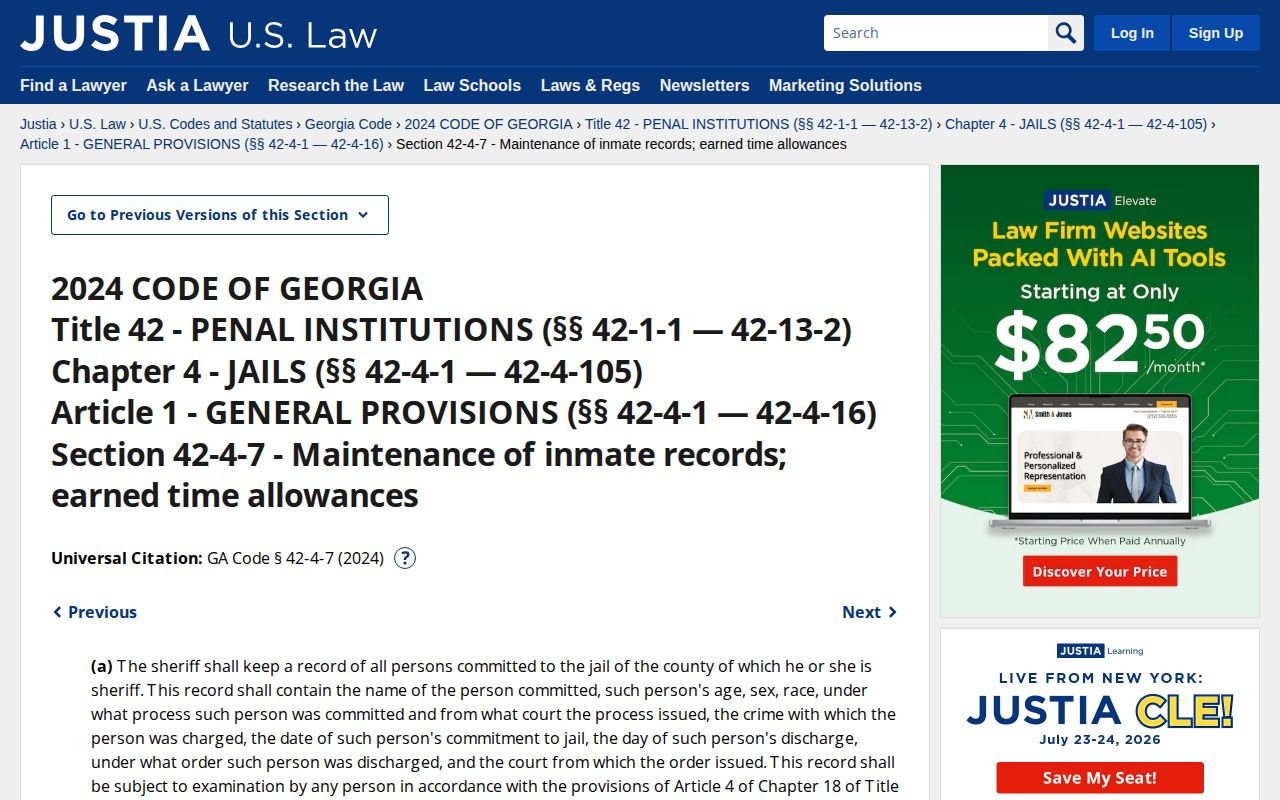
That statutory record is more reliable for a completed local release than treating disappearance from the current roster as a date calculation.
Hays State Prison Release Dates
A Hays State Prison date follows the state system. The GDC orientation handbook says the court's sentence determines the maximum release date, the longest period the person can spend in prison unless sentence service is interrupted. It also says the full sentence is served unless parole or a court-ordered sentence reduction applies. The maximum date is therefore not the same as the date on which parole may begin.
The State Board sets a tentative parole month, or TPM, for eligible cases. A TPM is the month when the Board expects final review and, if appropriate, may set a parole release date. It remains conditional. Good conduct, program completion, new information, or a later Board action can postpone or cancel the plan. Do not report a TPM as an actual release.
| State field | What it means | What it does not prove |
|---|---|---|
| Maximum release date | Longest sentence end shown after GDC computation | That parole will not occur sooner |
| TPM | Tentative month for Board final review | A grant, final date, or completed release |
| Parole release date | Date tied to a Board release action | That community supervision has ended |
| Actual release date | Recorded state custody exit | That no parole, detainer, or later custody applies |
If the GDC result shows Hays as the facility, the person remains in state custody unless another status or release field establishes a change. If it shows a release date, compare the Board result and DCS assignment to learn whether the person entered community supervision.
Note: A state-prison release from Hays is not a Chattooga County Jail discharge, even though both facilities are inside Chattooga County.
Chattooga State Credits and PIC
Georgia state-prison credits use a different law from county earned time. O.C.G.A. § 42-5-101 authorizes GDC work incentive credits for eligible state inmates based on approved programs, work tasks, and behavior standards. It does not control a county sentence at the Chattooga jail.
GDC's Performance Incentive Credit program, called PIC, is an incentive reentry process. GDC describes eligibility in terms of satisfactory progress in education, vocational and treatment programs, work assignments, and good behavior. PIC may reduce length of stay for an eligible offender. It is not guaranteed, and the Board may reconsider eligibility when new information appears.
The captured GDC PIC program page shows the official source used for state-prison date questions:
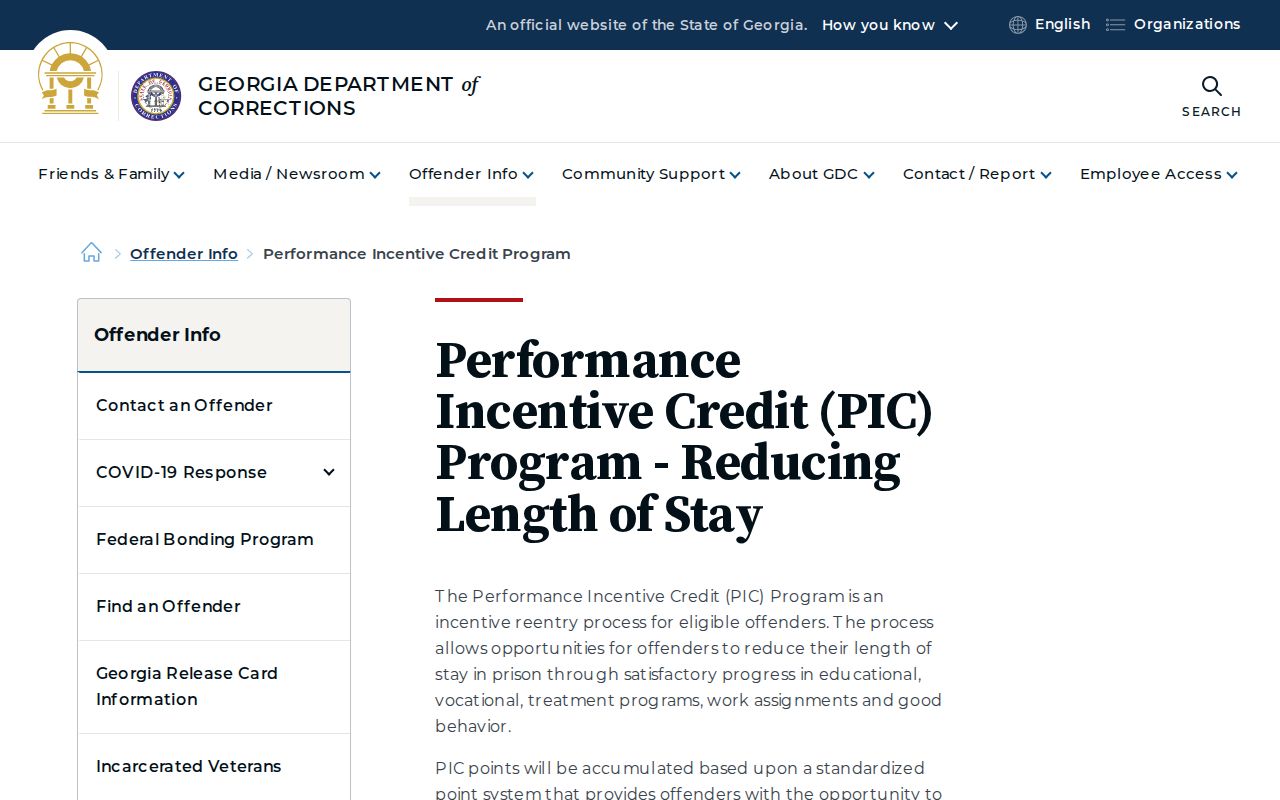
PIC should be treated as one state computation factor. It should never be converted into a promised number of days without an official record for the person.
Chattooga Release Is Not 85 Percent
Georgia has no universal rule that every inmate serves 85 percent. The calculation depends on the offense, sentence, custody system, and parole law. Under O.C.G.A. § 42-9-45, the general parole-consideration baseline is six months or one-third for a misdemeanor sentence and nine months or one-third for a felony sentence, whichever is greater. That is eligibility for consideration. It is not a right to release at that point.
Other categories are treated differently. The Board says non-life sentences for specified serious violent felonies with crime dates on or after January 1, 1995 are not parole eligible. It also identifies certain fourth-or-more felony recidivist sentences and life without parole as ineligible. Life-sentence and offense-specific rules add more variation. A simple percentage can therefore give a false Chattooga County projected release date.
The accurate state inquiry combines the court sentence, GDC maximum date, statutory eligibility, Board TPM or decision, PIC or work credits when applicable, and any later court order. For a county sentence, use § 42-4-7 instead. Keeping those systems apart prevents a state-prison rule from being misapplied to a local jail term.
Why Chattooga Release Dates Change
A release date can move before or after an expected date is published. Some changes come from a new legal order. Others come from sentence computation, parole review, credits, discipline, a transfer, or lag between an event and an online update. The source of the date tells which agency should explain the change.
| Factor | Possible effect | Best record to check |
|---|---|---|
| Bond, dismissal, or new court order | Creates or changes local release authority | Court order and sheriff discharge record |
| Jail credit or county earned time | Recalculates a county sentence end | Sentence, jail computation, § 42-4-7 record |
| Transfer or detainer | Ends one agency's custody but begins or continues another's | Jail history and receiving-agency record |
| GDC sentence computation | Updates the state maximum date | GDC offender and written records |
| Parole grant, denial, or postponement | Moves or removes a possible parole date | Board TPM and parole record |
| PIC, work credit, conduct, or program status | May alter state length of stay or parole planning | GDC and Board records |
| Weekend, holiday, or data refresh | Delays the visible update after processing | Releasing agency and court confirmation |
A release from county custody to GDC, USMS, ICE, or another county is not release to the community. The Chattooga jail record may correctly show a discharge while the receiving system shows continued custody. Read both records before concluding that a projected date has arrived.
Note: A web update delay can explain a stale date, but only the responsible agency can confirm the completed custody change.
Confirm a Chattooga Release Date
Confirmation should come from the system that held the person. For Chattooga County Jail, use the prior-inmate search, sheriff discharge record, and court order. For Hays or another state prison, use GDC, then the Board and DCS if parole applies. For a federal sentence, use BOP. An ICE locator result addresses immigration custody, not a county sentence end.
Georgia VINE can add a notice when a custody source reports release or transfer. It is useful for a pending change, but VINE is a notification layer rather than the official sentence or discharge record. Registration and coverage can vary by participating source. The VINELink Release Check gives the one-person search and alert process.
If the sources disagree, save the displayed dates and ask a focused question. For the sheriff, request the commitment and discharge record. For GDC, ask Inmate Records and Information to verify the maximum or actual release date. For the Board, distinguish TPM from a grant or parole order. For the court, request the sentence, bond, dismissal, modification, or revocation order that caused the calculation to change.