
Understanding Chattooga County Releases
A release from Chattooga County custody means the jail no longer holds the person under the same local booking. It does not always mean the person walked into the community with no other legal duty. A bond release, time-served discharge, dismissal, probation order, transfer, and release to another agency all end local custody in different ways. The public trail also changes with each result. OffenderIndex can retain booking and prior-inmate details, the sheriff keeps the jail discharge record, and the court file explains the order that caused the release.
The first question is which system held the person. Chattooga County Jail in Summerville handles local detainees and county inmates. Hays State Prison in Trion is run by the Georgia Department of Corrections, or GDC. A person leaving Hays has a state-prison record, not a county-jail release record. Federal custody and immigration custody form two more narrow paths. Matching the person to the right system prevents a missing roster entry from being mistaken for proof of release.
- Discharge
- The formal end of confinement under a stated order or sentence.
- Time served
- Release when credited confinement satisfies the term ordered by a court.
- Detainer
- A request or hold from another agency that can lead to transfer instead of community release.
- Parole
- Conditional community release from a prison sentence after a Board decision.
Chattooga County Release Types
The release type tells a reader where to check next. A county booking can close after bond while the court case remains open. A transfer to GDC ends county-jail custody but starts state custody. Parole ends prison confinement while the sentence continues under supervision. The sheriff record and the court order should be read together when the wording is unclear.
| Release type | What it means | Next record |
|---|---|---|
| Bond or recognizance | Local custody ends under bond terms or a release order. | Jail discharge record and court bond order |
| Time served or sentence end | The local term is satisfied after credit and any lawful earned time. | Jail record and sentencing order |
| Dismissal or court order | A judge or prosecutor action changes the basis for custody. | Final disposition or dismissal entry |
| Probation | Confinement ends, but a court-ordered community term may begin. | Court order and named probation provider |
| GDC transfer | The person leaves the county jail for state-prison custody. | GDC Find an Offender |
| Other-agency transfer | Another county, USMS, BOP, or ICE may receive custody. | Receiving agency and court records |
Can a transfer count as a release? It is a release from the Chattooga jail booking, but not a release from custody. The receiving agency must be checked before assuming the person is free.
Chattooga Release Record Fields
O.C.G.A. § 42-4-7 gives unusually clear detail about the county jail record. The sheriff must record each person's identifying data, the process and court that caused commitment, the charge, the commitment date, the day of discharge, and the discharge order and court. These fields do more than show an empty roster result. They tie the end of a jail stay to a legal source.
| Field | What it shows |
|---|---|
| Name, age, sex, race | Identity details used to distinguish similar names |
| Commitment process and court | The warrant, order, or process that placed the person in jail |
| Crime charged | The stated charge tied to that commitment |
| Date of commitment | When the jail stay began |
| Day of discharge | The formal local release date |
| Discharge order | The authority under which the jail released or transferred the person |
| Issuing court | The court behind the discharge order |
OffenderIndex adds useful web fields such as arrest date and time, booked status, days in jail, bond, charges, warrant number, sentence, release date, and prior booking or release history. Those screen fields are good search clues. A formal need is better served by the statutory jail record and the matching court order because the public page does not publish a retention period or exact update schedule.
Request Chattooga Release Records
The Chattooga sheriff open-records form is the direct route when a past booking is missing or the discharge authority matters. A focused request reduces search time. Name the person, approximate booking period, arresting agency, case or warrant number if known, and each desired item. Ask for the booking record, commitment and discharge record, day of discharge, release authority, bond or release type, and any legally releasable photo as separate items.
- Search the public booking-date tab first and save the identifiers shown.
- Complete the sheriff form with a narrow date range and a purpose-neutral record description.
- Cite the jail record kept under O.C.G.A. § 42-4-7 when asking for discharge fields.
- Choose review, pickup copies, or mailed copies on the form.
- Review any cost estimate before production and compare the result with the court order.
The form cites O.C.G.A. § 50-18-71. Search, retrieval, review, copying, mailing, and supervised inspection may carry charges. Hourly cost may begin after the first fifteen minutes at the rate of the lowest-paid qualified full-time employee, and an estimate is supplied when charges apply. The county identifies Mark A. Shrader as sheriff. The general line is 706-857-3411; GDC separately lists the jail line as 706-857-0721.
Chattooga Release Record Limits
Public access is broad, but it is not unlimited. Juvenile files are not general public release content. Sealed or restricted records may not appear through ordinary online channels. Georgia record restriction under O.C.G.A. § 35-3-37 can change access to qualifying criminal-history entries, yet it does not promise that every old publication will vanish. For arrests after July 1, 2013, the GBI directs a person to the prosecutor; older arrests use the arresting agency process.
A missing online row does not prove restriction, dismissal, or release. Confirm the jail discharge record and the court disposition.
The public OffenderIndex page offers a previous-inmate search but states no retention term. A court file may therefore outlast the online jail display. PeachCourt may provide file-stamped documents from many Georgia state and superior courts, while sealed, adoption, and unexecuted proposed orders are excluded from its general document access. The Chattooga clerk remains the official source for local court files.
Find Chattooga County Released Inmates
A released-person search should move from the narrow local roster to the lasting record. Start with exact first and last names. If the person is absent from Current Inmates, do not stop. The absence may reflect bond, discharge, transfer, a name variation, or a data delay. Use the booking-date search and enable previous inmates. Then follow the custody type shown by the record.
- Check Current Inmates to rule in an active Chattooga jail listing.
- Run Inmates by Booking Date around the likely arrest and select Include Previous Inmates.
- Use record details for release date, history, sentence, bond, court, and warrant clues.
- Check GDC if the person entered state-prison custody or left Hays State Prison.
- Use the court file to explain bond, dismissal, sentence, probation, revocation, or transfer.
- Check Board, DCS, VINE, BOP, or ICE only when that custody path fits.
- Request the sheriff discharge record when online results are missing or unclear.
The same-day view has a narrower purpose. Chattooga publishes Bookings Over Last 24 Hours, not a proven release feed. Test those recent bookings for a later release entry through record details and official confirmation. A person can appear there and still be held.
Chattooga Previous-Inmate Search
The most useful county-specific control is the checkbox labeled “Include Previous Inmates In Search.” It sits on the Inmates by Booking Date tab. Choose dates that cover the booking, not merely the suspected release day. The page warns that including previous inmates may take more time, which is consistent with a larger history query. Leaving both date boxes blank may broaden the result, but a tight range makes identity checking easier.
Search results can expose booked status, arrest time, bond, charges, court, sentence, release date, and earlier booking or release dates through detail and history areas. The system code also contains a photo field, though Chattooga's public setting has photos turned off. That makes the lookup useful for status and record clues, not a dependable photo gallery. No public cadence or history-retention period was found, so older records should move to the sheriff form and court file.
Note: The 24-hour tab tracks bookings, while the booking-date tab with prior inmates is the stronger local release search.
GDC Search for Chattooga Releases
The GDC Find an Offender search is for a person who entered Georgia state-prison custody. It is not the right first tool for someone who only bonded out from Chattooga County Jail. GDC can show charges, facility location, and release date, and offender photographs appear automatically when available. A record that still names Hays or another active facility should be treated as state custody unless a release or discharge field says otherwise.
| Search field | Best use | Check afterward |
|---|---|---|
| Name | Start with exact spelling, then broaden | Age and identifiers |
| GDC ID | Match a known state offender number | Facility and status |
| Case number | Connect state custody to a court case | Sentencing court file |
| Age and traits | Separate people with similar names | Photo if available |
| Release date | Shows the state record's release field | Board and DCS when parole applies |
GDC tells users to verify important information in writing with Inmate Records and Information, P.O. Box 1529, Forsyth, GA 31029. A maximum release date is the longest sentence-based prison date unless sentence service is interrupted or changed. A tentative parole month, or TPM, is a Board review marker, not a final release order.
Chattooga Release Court Records
The jail record can show when custody ended. The court file explains why. This is especially useful in Chattooga County because the clerk manages Superior, State, and Juvenile Courts, and different case types may also involve Magistrate or Probate Court. Felony dispositions usually lead back to Superior Court. A bond order, sentencing entry, dismissal, nolle prosequi, probation order, or revocation order can explain a release entry that looks vague online.
The GSCCCA Chattooga clerk listing identifies the official office at 10035 Commerce Street in Summerville, open Monday through Friday from 8:30 a.m. to 5:00 p.m., with phone 706-857-0706. The screenshot below shows that county-specific clerk route.
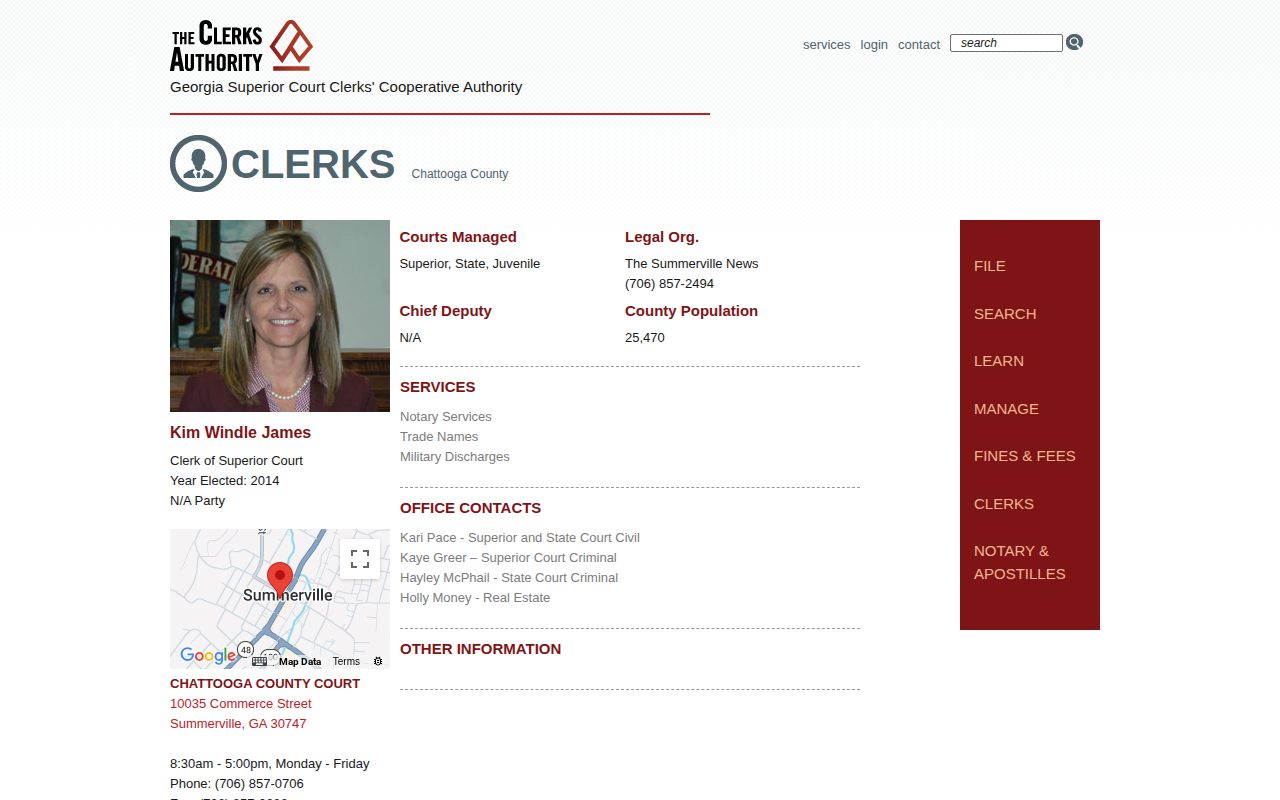
That clerk result gives the lasting local contact when a jail release needs a matching bond, sentence, dismissal, or probation record. PeachCourt is an added document-access channel, but the clerk is the custodian and the fallback.
Hays and Chattooga Releases
Hays State Prison creates a local search split that many counties do not have. It is physically in Chattooga County, at Trion, but it is a close-security GDC prison for adult male felons. Chattooga County Jail is in Summerville and remains a county facility. The shared county name does not merge their records. A Hays release goes through GDC, the State Board of Pardons and Paroles when parole applies, and DCS for community supervision.
A release from Hays may be parole, maximum-sentence discharge, or another state-authorized outcome. Parole changes confinement into supervised community status; it does not mean the whole sentence has ended. The GDC record supplies the state custody and release fields, the Board supplies TPM or parole status, and the DCS LaFayette Field Office supplies the local supervision route for Chattooga. The county jail lookup cannot confirm any of those state-prison steps.
Which facility should be searched? Use OffenderIndex for a Summerville county-jail booking. Use GDC for Hays or another Georgia prison.
After a Chattooga State Release
GDC publishes a Georgia Release Card process for funds left in a state prison account. This is a post-release logistics detail for someone leaving Hays or another GDC facility, not a county discharge record. The card route does not confirm why a person was released, and it does not replace the offender search. It addresses the delivery and activation of remaining account funds after state release.
The custody record should still be checked first. If parole follows, the released person may need to report under DCS instructions. Chattooga County is served by the DCS LaFayette Field Office rather than an office labeled for Summerville. The Board makes the parole decision; DCS manages felony probation and parole supervision in the community. Misdemeanor probation is different because DCS oversees the system but does not itself supervise each misdemeanor probationer.
Chattooga Release Alerts and Transfers
Georgia VINE provides custody-status checks and notifications by web or at 1-833-216-6670. Search for the correct person, compare identifiers, and register for a release or custody-change alert if the record is available. A VINE release status is a signal from the contributing agency. It does not replace the sheriff's discharge entry, GDC record, or court disposition.
Federal and immigration paths apply only when a hold, case, sentence, or transfer supports them. The BOP Inmate Locator covers federal inmates from 1982 forward and may show a release date or no current BOP custody. ICE's locator checks current adult ICE custody and certain CBP custody after more than 48 hours. USMS manages federal prisoners between arrest and acquittal or delivery to BOP, but it has no public release list like the county roster. No official source reviewed established a current Chattooga ICE detention contract.
Release to another agency ends the county booking, but the person may remain in custody elsewhere.
Chattooga Release Status Compared
Each source answers a different question. Current Inmates asks whether the county system lists the person now. Prior-inmate search asks whether a past county booking can still be found. The jail discharge record provides the formal day and authority. GDC handles state-prison custody. The court explains the legal outcome, while Board and DCS records explain parole or felony supervision.
Still in county custody: a current OffenderIndex listing is the starting signal.
Released from county jail: use previous inmates, the sheriff discharge record, and court order.
Transferred to state prison: use GDC, not the county's current roster.
Released on parole: check the Board decision and DCS supervision route.
Federal or ICE custody: use BOP or ICE only when the case or hold supports that path.
Chattooga County Release Facilities
Two detention facilities belong in the local release map. Chattooga County Jail holds local detainees and county inmates; releases lead to the community, court-ordered supervision, GDC, another county, or another agency. Hays State Prison holds sentenced state offenders; releases lead through GDC discharge or parole records and may continue into DCS supervision.
- Chattooga County Jail, Summerville: county booking, prior-inmate, sheriff discharge, and court-record path.
- Hays State Prison, Trion: GDC, Parole Board, DCS, and sentencing-court path.
These systems should never be substituted for one another. The correct facility name on the last known record controls the search route.